

Google NotebookLM: The AI Tool More People Should Be Paying Attention To
Information Overload Is the Real Challenge
We are surrounded by more information than ever before.
Research papers, industry reports, YouTube videos, meeting recordings, articles, PDFs, training materials, and internal documents accumulate faster than most people can process them. The challenge is no longer finding information—it is making sense of it.
Many AI tools focus primarily on content generation. Far fewer help users organize, understand, and extract meaningful insights from large volumes of information.
This is where Google NotebookLM distinguishes itself.
NotebookLM has quickly developed into one of the most capable AI-powered research and knowledge-management tools available today. While many users rely on AI chatbots for brainstorming and quick answers, experienced researchers, students, and professionals are increasingly turning to NotebookLM to build structured, personalized knowledge systems.
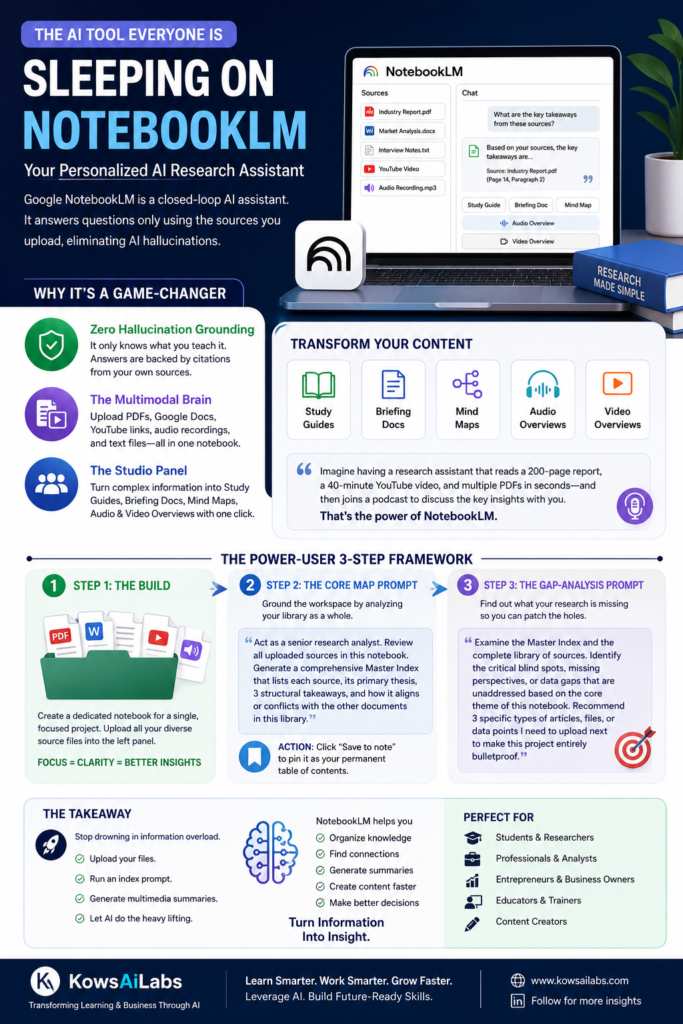
What Makes NotebookLM Different?
Unlike conventional AI chatbots that draw from broad internet knowledge, NotebookLM operates within a more controlled environment.
It functions as a source-grounded AI assistant.
Rather than searching the web, it works exclusively with the materials you provide, including documents, links, videos, audio recordings, and personal notes. This approach offers several significant advantages.
1. Fewer Hallucinations and Greater Reliability
Because NotebookLM references only uploaded sources, its responses remain closely tied to actual content rather than generalized assumptions.
When answering questions, it also provides citations that link directly to the source material, making verification much easier.
2. A Unified Knowledge Repository
NotebookLM allows users to bring multiple content formats together in a single workspace, including:
- PDFs
- Google Docs
- YouTube videos
- Audio recordings
- Text files
- Research notes
Instead of managing information across numerous applications, users can create a centralized, searchable knowledge hub where ideas become interconnected and easier to navigate.
3. AI-Powered Content Transformation
One of NotebookLM’s most impressive capabilities is its Studio Panel.
With minimal effort, users can convert complex source material into:
- Study guides
- Briefing documents
- Mind maps
- Audio overviews
- Video summaries
As a result, the platform serves a wide range of audiences, from students and educators to consultants, entrepreneurs, and content creators.
A Practical Framework for Using NotebookLM Effectively
Many people approach NotebookLM as though it were simply another chatbot. Doing so overlooks much of its value.
Its true strength emerges when it is treated as a research operating system rather than a conversational assistant.
Step 1: Build a Focused Knowledge Base
Create a dedicated notebook for a specific project or objective.
Examples might include:
- Competitor analysis
- Market research
- AI learning
- Course development
- Business strategy
- Industry research
Avoid combining unrelated topics within the same notebook. Focused collections produce more coherent insights and more accurate responses.
Once the notebook is established, upload all relevant reports, articles, videos, notes, and supporting materials.
Step 2: Create a Master Index
Before diving into detailed questions, establish a high-level overview of the entire knowledge base.
Use the following prompt:
Act as a senior research analyst. Review all uploaded sources in this notebook. Generate a comprehensive Master Index that lists each source, its primary thesis, three key takeaways, and how it aligns or conflicts with the other documents in this library.
Save the resulting output as a note.
This document becomes a living table of contents that helps you understand the structure, themes, and relationships within your research collection.
Step 3: Conduct a Gap Analysis
Once the knowledge base is organized, identify areas where information may be incomplete.
Use this prompt:
Examine the Master Index and the complete library of sources. Identify critical blind spots, missing perspectives, or data gaps related to the core theme of this notebook. Recommend three specific types of articles, files, or data points that should be added to make this project more comprehensive.
This step is frequently overlooked, yet it often delivers the greatest value.
Rather than merely organizing information, NotebookLM begins highlighting weaknesses, unanswered questions, and opportunities for deeper investigation.
The result is a more balanced and comprehensive research foundation.
Practical Applications
Students
- Exam preparation
- Research assignments
- Study guide creation
- Concept mastery
Professionals
- Industry research
- Skill development
- Meeting analysis
- Learning new subject areas
Entrepreneurs
- Market analysis
- Competitor research
- Product evaluation
- Business planning
Educators and Trainers
- Course design
- Content development
- Research synthesis
- Resource organization
Content Creators
- YouTube research
- Article development
- Podcast preparation
- Newsletter planning
The Real Value of NotebookLM
Most people are not suffering from a lack of information. They are struggling with an excess of it.
NotebookLM helps bridge the gap between information and understanding.
Rather than spending hours manually reading, organizing, and summarizing documents, users can build structured knowledge systems that support learning, decision-making, and content creation.
The objective is not to consume more information.
The objective is to learn more efficiently, think more critically, make better decisions, and produce higher-quality work.
Final Thoughts
As artificial intelligence continues to evolve, the most valuable tools are not always the most widely discussed.
Google NotebookLM may be one of the most underappreciated AI platforms available today.
For anyone who regularly works with research, reports, educational content, business documents, or creative projects, it deserves serious consideration.
Instead of drowning in information, build a structured knowledge base, generate a Master Index, identify critical gaps, and allow AI to handle much of the organizational workload.
The future will belong not to those who collect the most information, but to those who can transform information into meaningful insight.
KowsAiLabs
Transforming Learning and Business Through AI